Previous posts in this series:
The Proposal:
1. Eliminate any weighted lottery system. Abolish compounding tickets: one ticket per entrant, per year.
2. Create a stratified, multiple sub-lottery system comprised of four groups: Never-Starters, Veterans, Super-Masters, Everyone Else. Lottery odds are based on number of times a runner has run the event, not number of tickets.
*****
Background. This proposed lottery alternative is based on two pre-existing systems: the original (basic) Western States lottery, and components of the stratified lottery system current employed by The Hardrock Hundred Endurance Run (HR100).The former - a simple, "one year, one ticket" basic lottery - was the original lottery strategy of Western States from 1981 until 2011, when then first weighted system, "n+1", was instituted. This system, while blind to both experience, previous runs, and previous lottery attempts, also eliminates any incentives for entering prematurely, or continuing to enter in order to “keep my tickets”.
The latter is a lottery system developed by The Hardrock 100: a stratified lottery system consisting of three separate lotteries, one each for:
- First-Timers
- Veterans (5 or more finishes)
- Everyone Else
The Details. Here is a detailed explanation of the proposed alternative:
1. Eliminate any Weighted Lottery System
De-incentivize premature entry by abolishing the compounding ticket system, entirely. This includes both the current "2n-1", as well as the preceding "n+1" system.
The only way to curb the trend of premature entry is to eliminate a geometric entry system that rewards it. With entrant numbers skyrocketing and all entry odds plummeting, runners know fully well this reality: "If I want to ever run Western States I have to enter now".
Below are some interesting data:

This is the overall growth of lottery entrant per year, dating back to 2000. Two important milestones are worth noting:
- the n+1 lottery began in 2011
- the geometric system began 2012
Next, take a look at this graph:
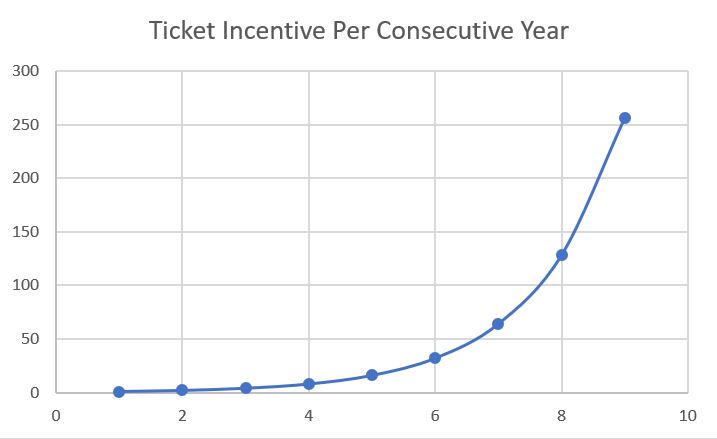
This represents the growth of one’s ticket cache, for each consecutive year of entry.
It’s impossible to prove that a geometric system can definitively cause the geometric growth currently observed in the lottery.
It’s impossible to prove that a geometric system can definitively cause the geometric growth currently observed in the lottery.
However, basic economics tells us: a geometric incentive will create a geometric demand.
Returning to the Western States entry data: when superimposing the historic changes to the lottery, the correlation between those changes and the resultant entry numbers becomes more compelling:
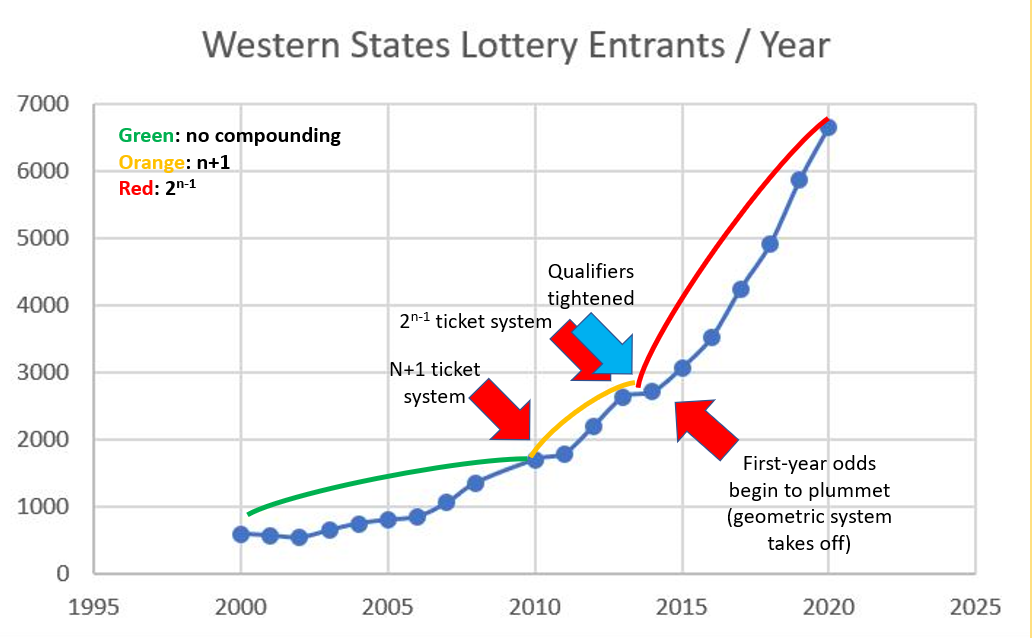
This hybrid chart superimposes the history of the lottery: what changes were made, when, and the correlated changes in applicants.
Note three fairly distinctive slopes in the history of the Western States lottery: the basic lottery era, the “n+1” years, and the geometric system. (Also note the small plateau that occcured in 2014 after the tightening of qualifier races).
Looking closer at each period:
Note three fairly distinctive slopes in the history of the Western States lottery: the basic lottery era, the “n+1” years, and the geometric system. (Also note the small plateau that occcured in 2014 after the tightening of qualifier races).
Looking closer at each period:

From 2000 to 2010, a basic lottery was held that also included the Two-Time-Loser clause: if you entered twice before and we're not picked, you would automatically enter.
Growth was relatively steady until the end of the decade. Growth was modest early on (+50-100 added applicants per year).
During this time of 500 or less applicants, the "Two-Time Loser" functioned well. But once interested piqued in the late 2000s, this initial incentive was quickly overwhelmed.
(Note: a reader might think that the Two-Time-Loser was a major incentive. It wasn't. If anything, it was a dis-incentive to prematurely apply because it guaranteed entry. Why rush to something you're guaranteed to get? Additionally: at this time with the basic lottery, odds were still holding at 50% for all applicants).
Growth was relatively steady until the end of the decade. Growth was modest early on (+50-100 added applicants per year).
During this time of 500 or less applicants, the "Two-Time Loser" functioned well. But once interested piqued in the late 2000s, this initial incentive was quickly overwhelmed.
(Note: a reader might think that the Two-Time-Loser was a major incentive. It wasn't. If anything, it was a dis-incentive to prematurely apply because it guaranteed entry. Why rush to something you're guaranteed to get? Additionally: at this time with the basic lottery, odds were still holding at 50% for all applicants).
As total applicants began to triple and even quadruple the maximum allowable field size, it became clear that in a basic, indiscriminate lottery, eventual selection could take inordinately long. Moreover, a guaranteed entry after two "losses" became impossible. Thus, the Two-Time Loser clause had to be abandoned and the “n+1” system was conceived and implemented for the 2011 race:
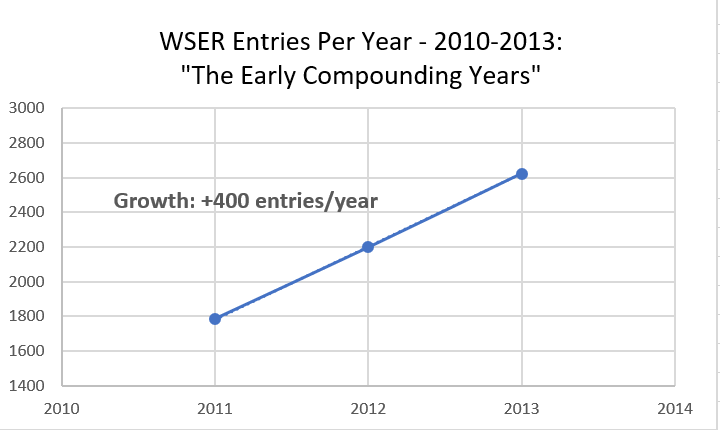
Correlating with the implementation of “n+1”, we see a growth increase of upwards of 400 applicants per year from 2011 to 2013.
Somewhere along the line, the Race got even more concerned and felt that additional protections be put into place to allow for a more expedient and “guaranteed” entry for committed runners. The 2n-1 system was implemented in 2013 (of note: tickets were retroactively compounded for 2nd and 3rd-year applicants from the previous n+1 system):

From 2014 through the 2020 lottery, growth began in this period at 400 applicants per year and has progressively increased to a current annual growth rate of 800-1000 applicants per year. The race now increases in applicants per year, more than double the total applicant numbers (~500) from 20 years ago.
While correlation does not equal causation, the changes made to the lottery do, in fact, act like independent (input) variables with a dependent variable (applicants) result: an adjustment “X” yields in a change of “Y”.
But indeed, it is just a correlation that is impossible to prove.
Additionally, one could argue that growth in Western States also correlates to overall growth ultrarunning.
Here is that data comparing Western States applicants and the total number of hundred-mile finishers in North America.

A cursory look would say that the Western States applicants fairly neatly correlate with overall growth in 100-mile finishes.
They do, early on: before the weighted lotteries began.
But looking closely, at 2015 and beyond - when the geometric lottery system really took hold at Western States:

And what you’ll see is that, despite an ever-increasing number of new hundred-miler races in North America (not all of which are Western States qualifiers -- thus this group can grow, independently), Western States lottery applicants have grown at nearly double the rate of the rest of the 100-milers on the continent.
Something else is driving that additional growth.
Has Western States gotten that much cooler since 2015?
One could argue that the modern “documentary era” - from films such as Unbreakable (2011) - can spike interest in Western States more than the rest of the sport. However, two counter-points:
- Other (and equally compelling) documentaries for other races abound
- Western States has always had (and initially cornered the market in) cool documentaries
Have any other changes to the race occurred in the last five-plus years to account for the growth?
The biggest change: an incentivized lottery system.
One compelling experiment: abolish the weighted system, and track the next five years of applicant data. I predict applicants would drop precipitously - by jettisoning the premature entries - and once again align with the overall growth trend in 100-mile finishes.
Returning to the geometric data and the frightening right side of the chart:
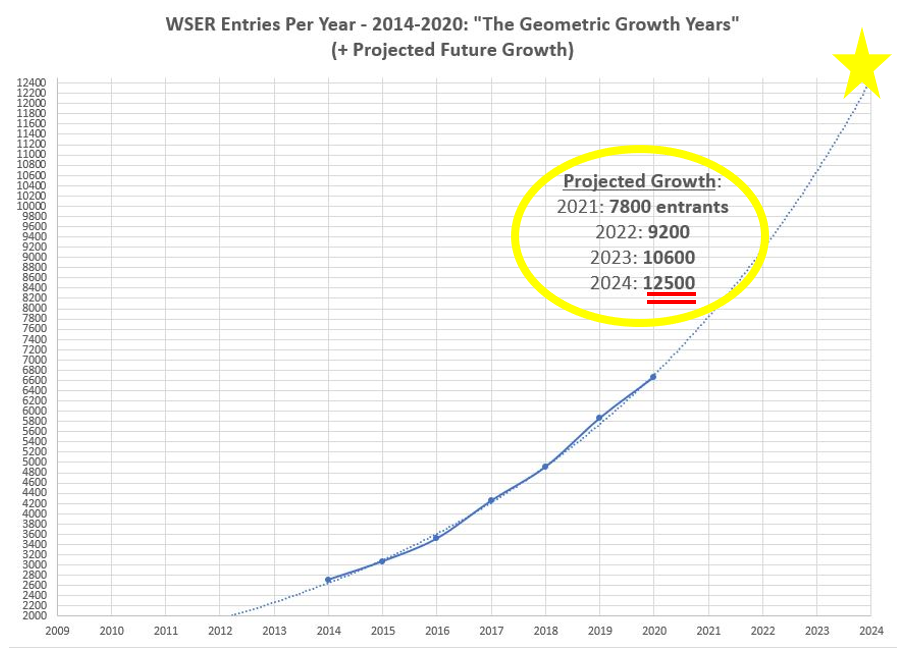
If this growth continues at the same rate - far exceeding the growth of all other hundred-milers - we may see this year’s record number of applicants double in four years.
It’s worth considering if the very system devised to handle growth, is in fact, the overt cause.
I hope I’m wrong. But if I’m not:
*****
Eliminating a weighted system would potentially decrease the rapid growth in lottery applicants by all-but-eliminating two substantial cohorts of "premature runners":
A. First-Timers “Getting in Line”. After running his/her first qualifying race, current prospective first-time Western States runners face a dilemma:
enter the lottery now, regardless of readiness or willingness to run this year
-or-
wait, and face worsening first-year ticket odds with each passing year
That is the reality, as single-ticket odds have plummeted in the past five years: on average, shrinking in half with each passing year.wait, and face worsening first-year ticket odds with each passing year
In fact, for today’s new entrants, the geometric lottery has become a version of The Red Queen’s Race: “It takes all the running you can do, to keep in the same place!”
The second group of "premature" entrants:
B. “Fatigued but Compulsive” Multi-Year Applicants. Even if a prospective runner is fully prepared and hungry to race when entering the lottery their first year, life happens.
As you can see in the data, there is always a drop off from year one to year two of entrants (that cannot be solely accounted for by being selected). But in those early years, the ticket growth is rather linear:
Year 1: 1 ticket
Year 2: 2 tickets
For runners who have applied in three consecutive years, the incentive to continue applying becomes more palpable:
Year 3: 4 tickets
For runners who have applied in three consecutive years, the incentive to continue applying becomes more palpable:
Year 3: 4 tickets
Year 4: 8 tickets
But preparation and desire to run is neither linear, nor geometric. Sometimes it goes down: for various reasons, after several years of commitment, an entrant might lose either the physical or mental ability or willingness to enter.
Yet the geometric ticket doubling continues, gaining real steam:
Year 5: 16 tickets
But life goes on, too: kids, family, work, injury illness. The new once-in-a-lifetime Lottery Bye provides a one-time year of respite from the grind of qualifying.
But once used up, multi-year applicants get stuck in a position of "accrue it or lose it": either continue to apply, year after year, or "crap out" and lose all of your "ticket earnings".
This fear of ticket bankruptcy creates another cohort of "premature entry": veteran lottery losers who are compelled to qualify, apply and accrue (often in very large, high-end geometric volume) during years in which they may not be willing or able to run.
But preparation and desire to run is neither linear, nor geometric. Sometimes it goes down: for various reasons, after several years of commitment, an entrant might lose either the physical or mental ability or willingness to enter.
Yet the geometric ticket doubling continues, gaining real steam:
Year 5: 16 tickets
But life goes on, too: kids, family, work, injury illness. The new once-in-a-lifetime Lottery Bye provides a one-time year of respite from the grind of qualifying.
But once used up, multi-year applicants get stuck in a position of "accrue it or lose it": either continue to apply, year after year, or "crap out" and lose all of your "ticket earnings".
This fear of ticket bankruptcy creates another cohort of "premature entry": veteran lottery losers who are compelled to qualify, apply and accrue (often in very large, high-end geometric volume) during years in which they may not be willing or able to run.
Some examples include top Masters runner (and friend) Bob Hearn:
 |
| WS veteran and timed-run national team member, Bob Hearn, upon entering the 2020 lottery: “I do not want to run it next year! But the lottery forces me to apply anyway” |
I don’t fault Bob. He’s an accomplished runner with a lot of other goals and priorities. But his hand is forced: he either keeps applying (with hopes he “won’t get picked” this year, but maybe next), or give up and lose everything.
Preparation and desire are not linear. Besides injuries, illness, and the rest of Life, sometimes "qualification fatigue" -- the drain of having to plan for, gain entry to, and finish a Western States qualifier -- is too much and folks want a break:
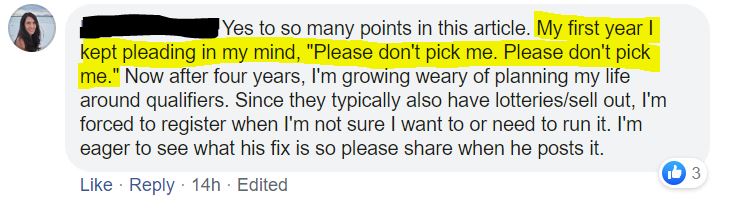 |
| A common refrain from first-timers, compelled to enter before they truly want to run: “Please don’t pick me”, followed a few years later by “qualifier-fatigue” |
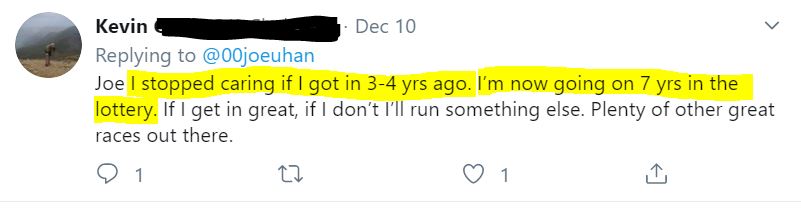 |
| “Stopped caring”, but has to keep applying, anyway. |
But should they give up, and give it all away?
With no recourse other than to continue to apply until they either “win or bust”, “qualifer-fatigued” runners are compelled to trudge onward, even if his/her will or readiness to run has waned. It’s better to continue than to unceremoniously lose all the tickets you’ve worked to “earn”.
Or, a runner incurs multiple illness or injury. Or multiple children.
Or, the finite list of qualifiers – and their restrictive lotteries – shuts them out.
After that Bye is used up, runners must let it ride each year and hope for the best. Or give up and lose it all.
What becomes of the runners who finally “crap out”? This is another elusive data set. Who is talking to them?
Coaches like me are. The nearly decade long “win or bust” of the Western States lottery has soured a lot of runners on Western States. Having never experienced the race, they’ve given up. At best, they’ve simply let it go. At worst, they’re jaded and bitter.
Precisely the opposite of what the race was intending to prevent.
(It’s worth noting that HR100 has unlimited lottery byes. This allows muti-time losers to take respite in any given year without losing tickets. But more importantly, it allows them to defer from a lottery when they don’t truly want to run that given year)
*****
The Purest Kind of Persistence is Un-Incentivized. A weighted system was intended to reward commitment and persistence to the effort of qualification and entry. And The Race has stated they wish to “reward persistence”: a characteristic worth reinforcing. But which type of behavior is more admirable?
A runner who applies year after year, incentivized with a “reward” of more (and more) tickets?
- or -
A runner who applies each year, with zero added incentive for repeat entry, motivated simply by the love of the race?
In a system stripped of artificial incentive, runners enter only when they’re all-in to run that year, knowing this year’s entry has no bearing on the next (or any subsequent) race year.
One ticket, one year. No incentive, no reward, no punishment. Just be ready to race, that year.
2. Create a stratified, multi-lottery system.
According to the mission of the race, WSER wishes to create a quality event that caters to a wide variety of runners, ranging from first-time hundred milers, to elite international runners, to veteran multi-time (10-Year Buckle) finishers.
A stratified lottery consisting of various sub-categories could distribute entries to these desired groups, without distortion from an incentivized, geometric system. Like other races (including HR100), WSER could adopt the following sub-categories of prospective entrants:
Never-Started. No WSER starts. (This is a notable distinction -- as opposed to finishes. See below).
Why: of course, the event wants to include first-time runners - whose energy and excitement provide the fuel for a special day. That said, the race also does not want to be flooded by the sheer volume of first-time applicants.
Veterans. Runners who have finished Western States multiple times. This could be five or more (as in the HR100 system), or, perhaps as many as eight finishes.
Why: Valuing veteran finishers is an implicit mission of the race. Who, exactly, they value and encourage to continue running is up for debate, and at the discretion of the Board. Under the current geometric plan, a notable and venerated group, the "Ten Year Bucklers" will become extinct. Unless you're an elite runner (gaining entry via a "Golden Ticket" qualifier, or previous Top Ten finish), or gain entry through repetitive sponsor, volunteer, or other Special Consideration entries, it will become exceedingly difficult to win the lottery enough times to gain ten starts.
Super-Masters. Over the age of 50. (No starts, or less finishes than a Veteran)
Why: This category recognizes that Super-Masters runners can run strong and compete well. This senior cohort also adds a degree of intrigue and magic to Western States. It also acknowledges that 50-plus year old runners simply cannot wait the five-to-ten years the current system demands.
Everyone Else. This group has run the race at least once, but less than Veterans (and is younger than Super-Masters).
Why: This cohort comprises all runners that have previously started Western States, yet does not have enough finishes to be considered a Veteran.
Benefits of a stratified System:
Consistent and pre-determined race diversity. One of the earliest concerns that prompted the new weighted lottery system was that new, first-time runners would overwhelm the lottery and crowd out the veteran runners.
Unlike a weighted system, where even multi-year entrants are drowned out by the glut of extreme ticket volumes, a stratified system protects the various cohorts of runners: race composition can be set by race leadership. Like Hardrock, Western States could appropriate a set number of entries per category, and run separate "mini-lotteries" from these groups. Doing so would allow each year's event to have a desired distribution of runners.
Moreover, this composition could be dynamic and based on the unique composition of the entrant pool from year to year. For example, if there happen to be very few Super-Masters entrants, those entries could be shifted to a different sub-lottery.
Such a system could also be employed to keep lottery odds consistent: entries could possibly shift from one cohort (say, Veterans) to another (Never-Starters) should demand in the latter increase far more than the former.
Values runners’ Experience instead of “Tickets”. In a situation with such extremes of supply-and-demand, more thought should go into what types of runners should be prioritized for such limited entries.
The current system is based solely on “tickets”: based solely on the number of years a runner has applied since his/her last race. And in this system, a single-ticket Never Starter entrant is on equal footing as a single-ticket runner with, say, three starts (but not quite a “veteran”, by number or character).
The entry system for Western States would be far more equitable in a stratified lottery system based on both number of runs, and age, versus an arbitrary ticket count.
This is possible in a stratified system without making the overall entry standards – either by qualifier options, distances, or speed – increasingly stringent. Separate sub-lotteries preserve opportunities for these different groups.
Indeed: it's impossible to award every interested runner an entry to Western States. However, the Board must decide the type of entrant it wishes to prioritize: First-Timers, or runners on their third or fourth run? Having already experienced Western States, why place a runner with several finishes equally amongst the Never Starter? This applies to any situation where a (1-to-4-start) “veteran” runner has the same number of tickets as a first-timer.
That's for the Board to decide, but it would seem to me, if the goal of Western States is to capitalize on the energy of new runners and their fans, while retaining the wisdom and magic of the veterans, the Board should adopt a "Barbell Strategy" that prioritizes the extremes:
- Never Started (0 starts)
- Veterans (at least X finishes)
- Super-Masters
Premature starts (& DNFs) become more costly. An interesting facet of a stratified system is it allows the race to differentiate from a Never-Starter and Everyone Else.
In the current system, there is no differentiation between tickets and experience. That also includes number of starts versus number of actual finishes. (While some websites such as ultrasignup.com track Did-Not-Finishes, I don’t’ believe Western States compiles this data in their lottery repository)
Note the distinction between “Never-Starter” (never run the race) versus “Never Finisher (X number of starts, but a possible DNF): A first-time runner who races, but fails to finish, would now transition to the Everyone Else cohort.
*****
Why This Plan.
- It is simple. It reverts to a basic lottery format.
- It is discerning. A stratified system allows a diverse, balanced entry field based on experience (not consecutive qualification) that guarantees no single cohort of runners will overrun race entries. First-timers, veterans, and - for the first time, older runners - will be prioritized and protected groups under this plan.
- It removes complexity and second-order effects. This system eliminates premature entry and in doing so, should significantly decrease the number of annual lottery applicants. Community wide, it frees runners from the bondage of perennial qualification, and takes tremendous second-order strain off qualifying races. A runner enters the lottery only when s/he is most interested. This is the way it should be.
Why Other Ideas Won’t Work (or Won’t Be Heard)
Over the past several years, I’ve heard a lot of different ideas about reforms to the Western States entry system. The vast majority of these ideas can be categorized in the following groups, and rather summarily dismissed:
Examples include:
Argument: “Make the race bigger [somehow]” / “Have [multiple] races”
This is the most often-cited - but extremely low-probability - solution. Most who make this argument fail to realize the origins of the 369 entrant limit.
Accepting that, the second-most common suggestion it to have multiple editions of the race: one for elite runners and one for everyone else. Assuming permits could actually be obtained for two races (highly unlikely), sequestering elite athletes from the every-day runners would be a tremendous cultural sea change: increasing exclusivity and losing the egalitarian purity and powerful magic that is “Everyone from Squaw to Auburn” on the same day. Such drastic change is one of the least likely to ever occur.
Lastly, even if the race could expand, it would need to expand at least one order of magnitude to make a palpable dent in current demand (“Linear Solution”). And if it did? Said “magic” hardly ever scales.
Argument: “We need to do away with [insert non-lottery entrant group: sponsors, aid stations, elites, Special Consideration, international]”
For one, the race now has over 6600 interested and qualified applicants. While the non-lottery entries number close to a hundred, a mere hundred entries is spitting into the wind when talking about 6600 entrants, and growing.
Secondly, the race values the diversity that different entry methods bring. Separate arguments can (and should) be made for each of these non-lottery entrant groups, but I will refrain from doing so, here.
Argument: “We need to make it harder to enter by [insert more challenging entry standard: race distance, time qualification, entry fee]”
Simply making it tougher to qualify or otherwise enter won’t stem the demand. It may create a temporary dent (as did tightening qualifiers in 2013-2014), but it would do very little to sustainably curb the demand that a geometric system generates unless taken to an extreme.
If taken to an extreme, it would create a powerful - and likely negative - cultural and anti-egalitarian impact (Charge $5000? Only sub-24 runners?). In doing so, you risk decreasing relevance of the race, and increasing negativity and bitterness.
Runners of all abilities running from Squaw to Auburn is a big part of the Western States magic. Any “make it harder” strategy decreases race diversity and detracts from that magic.
Argument: “How about two-to-the [insert even bigger number]?” The “Even More Tickets Argument”
Category: Increased Complexity.
Too many tickets - and the complex second-order effects that came with them - is what got us here. More tickets won’t make it better; only worse.
There’s no easy way to transition out of the weighted system. But the potentially least-painful way would include:
1. Immediate cessation of all ticket compounding. While no more tickets could be accrued, all runners who had previously accrued more than one ticket would retain them until:
For example:
2. Immediate implementation of the stratified system. Regardless of ticket numbers, runners would be sequestered into their applicable cohorts. Thus, a 64-ticket “Never-Starter” is no longer competing against an “Everyone Else” with the same ticket quantity. This immediately improves equity, as the preferred cohorts will have relatively better (pre-set) odds, while “Everyone Else” will have similarly worse odds.
3. All new applicants receive only one ticket. In this transition plan, the new applicants will unfortunately bear the brunt of absorbing the impact of the multi-ticket applicants. In year one, there will be no difference (as in the current system, first-time applicants get only one ticket). Second- and third-year applicants will no longer receive the weighted “benefit” of additional tickets.
There is no perfect solution, including this proposed alternative. Pure equity and fairness cannot exist in a situation with such a stark difference between supply and demand, and so many competing notions of who is most deserving for inclusion.
The first step toward the most coherent solution is a community-wide acknowledgement and acceptance of the following points:
As such, a third point must also be acknowledged:
Persistence is still rewarded, but without incentive to continue, nor punishment for stopping. In its place is increased optionality and freedom: runners can apply as many times as they want, as consecutively as they want, without invoking complex second-order effects that ripple throughout the ultrarunning community. Over time, as with the first three decades of the lottery, persistence will eventually reward them with entry, over time.
It seems pretty simple, but - finally - a runner can simply run a race because they truly want to run that race. Including Western States.
Dance with the one that brung you.
Lastly:
In this proposal, a first-time runner - prioritized in the Never-Started cohort, in a lottery not over-run by premature entries - has the best chance to quickly run his/her first Western States.
But after that, compared to the current system, will get much more difficult to get back in. One-and-done will be the most common thread connecting Western States runners.
1. Linear Solutions to a Geometric Problem. These ideas try to apply a “linear solution” - only a small number of increased entries - to a problem driven by a large (and geometrically-growing) demand.
2. Cultural/Philosophical Changes. These ideas would potentially result in a substantial and pervasive cultural/philosophical shift away from the current, historic, Western States as we know it.
3. Exclusivity/Anti-Egalitarian. Similar to the cultural changes, these proposals invariably increase exclusivity and strip away egalitarianism, a core value of the race.
4. Increased Complexity. These ideas add even more complexity to an already over-complex system. The more complexity, the harder it is to control, let alone anticipate unintended consequences. Thus any such idea will only make things worse.
Examples include:
Argument: “Make the race bigger [somehow]” / “Have [multiple] races”
Category: Linear Solution, Cultural/Philosophical, Exclusivity/Anti-Egalitarian, Increased Complexity
This is the most often-cited - but extremely low-probability - solution. Most who make this argument fail to realize the origins of the 369 entrant limit.
Accepting that, the second-most common suggestion it to have multiple editions of the race: one for elite runners and one for everyone else. Assuming permits could actually be obtained for two races (highly unlikely), sequestering elite athletes from the every-day runners would be a tremendous cultural sea change: increasing exclusivity and losing the egalitarian purity and powerful magic that is “Everyone from Squaw to Auburn” on the same day. Such drastic change is one of the least likely to ever occur.
Lastly, even if the race could expand, it would need to expand at least one order of magnitude to make a palpable dent in current demand (“Linear Solution”). And if it did? Said “magic” hardly ever scales.
Argument: “We need to do away with [insert non-lottery entrant group: sponsors, aid stations, elites, Special Consideration, international]”
Category: Linear Solution, Cultural/Philosophical
For one, the race now has over 6600 interested and qualified applicants. While the non-lottery entries number close to a hundred, a mere hundred entries is spitting into the wind when talking about 6600 entrants, and growing.
Secondly, the race values the diversity that different entry methods bring. Separate arguments can (and should) be made for each of these non-lottery entrant groups, but I will refrain from doing so, here.
Argument: “We need to make it harder to enter by [insert more challenging entry standard: race distance, time qualification, entry fee]”
Category: Linear Solution, Cultural/Philosophical, Exclusivity/Anti-Egalitarian
Simply making it tougher to qualify or otherwise enter won’t stem the demand. It may create a temporary dent (as did tightening qualifiers in 2013-2014), but it would do very little to sustainably curb the demand that a geometric system generates unless taken to an extreme.
If taken to an extreme, it would create a powerful - and likely negative - cultural and anti-egalitarian impact (Charge $5000? Only sub-24 runners?). In doing so, you risk decreasing relevance of the race, and increasing negativity and bitterness.
Runners of all abilities running from Squaw to Auburn is a big part of the Western States magic. Any “make it harder” strategy decreases race diversity and detracts from that magic.
Argument: “How about two-to-the [insert even bigger number]?” The “Even More Tickets Argument”
Category: Increased Complexity.
Too many tickets - and the complex second-order effects that came with them - is what got us here. More tickets won’t make it better; only worse.
*****
Transition Plan.
There’s no easy way to transition out of the weighted system. But the potentially least-painful way would include:
1. Immediate cessation of all ticket compounding. While no more tickets could be accrued, all runners who had previously accrued more than one ticket would retain them until:
- they are selected, or
- they fail to re-qualify (having already used the Lottery Bye).
For example:
- A runner with 64 tickets and no Western States starts would retain his/her 64 tickets and enter the “Never Started” sub-lottery.
- A runner with 4 tickets and one Western States finish would retain his/her 4 tickets and enter the “Everyone Else” sub-lottery
2. Immediate implementation of the stratified system. Regardless of ticket numbers, runners would be sequestered into their applicable cohorts. Thus, a 64-ticket “Never-Starter” is no longer competing against an “Everyone Else” with the same ticket quantity. This immediately improves equity, as the preferred cohorts will have relatively better (pre-set) odds, while “Everyone Else” will have similarly worse odds.
3. All new applicants receive only one ticket. In this transition plan, the new applicants will unfortunately bear the brunt of absorbing the impact of the multi-ticket applicants. In year one, there will be no difference (as in the current system, first-time applicants get only one ticket). Second- and third-year applicants will no longer receive the weighted “benefit” of additional tickets.
*****
Conclusions.
There is no perfect solution, including this proposed alternative. Pure equity and fairness cannot exist in a situation with such a stark difference between supply and demand, and so many competing notions of who is most deserving for inclusion.
The first step toward the most coherent solution is a community-wide acknowledgement and acceptance of the following points:
1. Not every interested runner will be able to run the Western States 100, even once. Many will never get a chance to run.2. “Deserving runners” will be left out, and “less-deserving” runners may get to run (multiple times).Once accepted, we can arrive at a solution that - while not necessarily “fair” (by the standards above) - is still simple, coherent, and - most importantly - free of far-reaching consequences and unintended side-effects.
As such, a third point must also be acknowledged:
3. “Persistence” - measured through consecutive application to the race lottery - cannot be incentivized
Persistence is still rewarded, but without incentive to continue, nor punishment for stopping. In its place is increased optionality and freedom: runners can apply as many times as they want, as consecutively as they want, without invoking complex second-order effects that ripple throughout the ultrarunning community. Over time, as with the first three decades of the lottery, persistence will eventually reward them with entry, over time.
It seems pretty simple, but - finally - a runner can simply run a race because they truly want to run that race. Including Western States.
Dance with the one that brung you.
Lastly:
In this proposal, a first-time runner - prioritized in the Never-Started cohort, in a lottery not over-run by premature entries - has the best chance to quickly run his/her first Western States.
But after that, compared to the current system, will get much more difficult to get back in. One-and-done will be the most common thread connecting Western States runners.
But that gives that one-timer - hopefully armed with a shiny buckle - an opportunity to give back: to spread that love and Western States magic and experience the race from all facets as volunteer, crew or pacer. Perhaps through those other avenues - volunteering, sponsors, or even elite performance - they earn enough finishes to be a Veteran.
Best of all, it accomplishes the three-pronged objectives that motivated the original lottery idea:
- to expose fresh blood to this iconic event
- to reward and recognize veteran runners for what they have to offer
- to create generation after generation of people - not just runners, but his/her friends and family - that are positively engaged with the race, and thus become, in perpetuity, part of the Western States Family


